How bacteria are used in wastewater treatment processes
We rarely think about it, but every day, millions of liters of wastewater are purified with the help of bacteria. Without them, our sewage treatment plants wouldn't work. They break down organic matter, reduce pollutants, and allow the water to be returned to nature. It's a proven biological process that society has relied on for a long time.
At Pure Effect, we asked ourselves a simple question: If bacteria are so effective at breaking down organic matter when it reaches the treatment plant, why wait until then?
Can the same biological principle be used where the dirt originates? The answer is yes. It's also the foundation of our approach to cleaning.
Wastewater treatment plants work with nature, not against it
When wastewater arrives at a treatment plant, it contains large amounts of organic matter: grease, food scraps, skin flakes, and other biological residues.
In the biological part of the treatment process, strong chemicals don't do the main work. Instead, the right conditions are created for bacteria to do what they've evolved to do over billions of years: break down organic matter with the help of enzymes.
It's essentially the same process that occurs everywhere in nature. When leaves turn into soil, when compost breaks down, or when organic matter disappears in the forest, microorganisms do the work. The treatment plant simply uses nature's own method in a controlled form.
Can the same biological principle be used in the home?
This is where Pure Effect's idea and function begin. In a traditional system, we clean our homes with chemical cleaning agents and water. Then, the dirt is transported to the treatment plant, where bacteria break down any remaining organic matter.
We believe that the best place to break down organic residues is where they originate, not only after they have been flushed away. Therefore, our products use the same biological principle as sewage treatment plants, but directly in the home. Selected bacteria and their enzymes begin to work right on the kitchen counter, bathroom floor, in our clothes, and other textile surfaces where organic residues accumulate.
However, this does not mean that biological cleaning is a new or unproven technology. On the contrary, biotechnological cleaning has been used for more than 30 years in professional cleaning, including in schools, hospitals, airports, sports arenas, and other public environments where large, heavily used surfaces with recurring dirt and odor problems are cleaned every day.
So why have you perhaps never heard of it? One explanation is that traditional chemical cleaning agents have long been the norm, both in professional cleaning and in the consumer market. Biological cleaning has existed in parallel, but has primarily been used where its long-term benefits have become particularly clear.
In the article "Why is biological cleaning used in professional cleaning?" we explain more about how the technology has evolved and why it is now becoming increasingly common even in home environments.
Organic residues are key
To understand why biological cleaning works, one must also understand what dirt often consists of.
In the home, this largely involves organic residues: grease from cooking, skin oil, soap residue, food spills, and other biological substances. It is these residues that can lead to grime, bad odors, and become nutrients for unwanted bacteria and other microorganisms.
Bacteria are specialists in precisely this. They produce enzymes that break down organic substances into smaller components that can then be used in their natural metabolism. This is the same biological principle used in nature and in wastewater treatment plants. It is also the same principle that underlies Pure Effect's cleaning products.
More than just cleaning
Traditional cleaning often involves dissolving dirt, encapsulating it, or moving it from a surface to a cloth or further down the drain.
Biological cleaning works differently in part. Here, organic residues are broken down biologically. Since the bacteria continue to produce enzymes for a period, cleaning can also continue after the actual cleaning is completed. This allows them to work even in pores, joints, and other hard-to-reach areas where mechanical cleaning has difficulty reaching.
The same idea behind Pure Effect's garment care
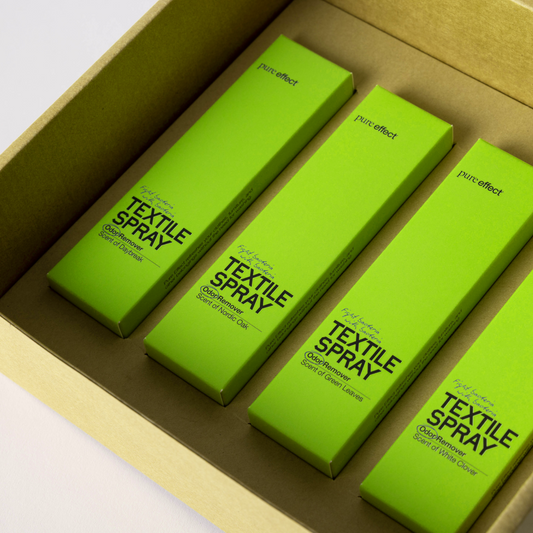
If you're familiar with Pure Effect's Textile Spray, you already recognize the principle.
On clothes, it's not the sweat itself that smells. It's the organic residues in the sweat and skin oil that become nutrients for odor-producing bacteria. That's why our bacteria work to break down the very source of the problem instead of just masking the odor with perfume.
In the same way, our home cleaning products work. The focus is not on creating a sterile environment, but on breaking down the organic residues that are behind many of the problems we experience as dirt, odor, and grime. At the same time, they outcompete bacteria that can otherwise create odors.
A different way of looking at cleaning
Biotechnology is actually nothing new. Humans have used microorganisms for thousands of years to bake bread, brew beer, make yogurt, and ripen cheese. Today, the same basic principle is used in everything from pharmaceuticals and biogas to water purification and environmental remediation.
Pure Effect is a practical application of the same mindset. Instead of trying to solve all cleaning problems with more chemicals, we use the natural ability of microorganisms to break down organic matter. It's not about replacing all traditional cleaning, but about using biology where it is most effective.
That's why we believe biological cleaning is the future
The more we learn about microorganisms, the clearer their importance becomes. They build soils, purify water, help our bodies, and drive many of nature's most important cycles.
For us, it is therefore natural to also let them help in the home.
We don't see our products as just another cleaning agent. We see them as a way to use a biological process that nature and our wastewater treatment plants have relied on for a long time, but directly on the surfaces where the dirt originates.
This is the core of our cleaning concept. Simple, effective, and gentle on the surfaces being cleaned. That's why we believe that the future of cleaning is just as much about biology as it is about chemistry.
FAQ - Frequently Asked Questions
Do wastewater treatment plants use bacteria to purify water?
Yes. Biological treatment is one of several steps in a wastewater treatment plant. Microorganisms help to break down organic matter and purify the water before it is returned to nature.
What are the different stages in a wastewater treatment plant?
Simply put, purification is usually divided into mechanical, biological, and chemical treatment. Mechanical treatment removes debris and particles, biological treatment uses microorganisms to break down organic matter, among other things, and chemical treatment is primarily used to remove phosphorus.
Which bacteria are used in wastewater treatment plants?
It's not a single bacterial species that does the job. Wastewater treatment plants rely on complex communities of many different bacteria and other microorganisms with various functions. Different species of Bacillus can be present as part of these microbial communities.
Does Pure Effect use the same bacteria as wastewater treatment plants?
No. Pure Effect specifically uses Bacillus subtilis in spore form. The commonality is instead the biological principle, to use the natural ability of microorganisms to produce enzymes and break down organic matter.
Is cleaning with bacteria a new technology?
No. Microorganisms have long been used to break down organic matter, including in water purification. Biotechnological cleaning has also been used in professional cleaning for more than 30 years. Pure Effect uses the same basic biological principle in cleaning homes and textiles.
Related reading
- What is biotechnology?
- What is a microorganism?
- Why is biological cleaning used in professional cleaning?
- Do you have proof that it works?